
AI Governance Is Not a Policy Problem. It's a Design Problem.
Most AI governance strategies fail because they live in PowerPoint, not in architecture. Here's how to design governance into your systems before implementation, not after failure!

In the last post, we talked about why AI ROI models fail. They’re essentially modeled after deployment, not decisions. When ROI is disconnected from business outcomes, governance becomes the next casualty. Leaders tend write 40 to 60-pages policies no one reads, audit frameworks no one enforces, and ethics documents no one references.
Governance becomes theater (though it usually is because no body cares to write one for implementation). It’s becomes a compliance checkbox, not a system to manage risk.
I’ve watched this pattern destroy AI projects for 15 years across multi-million dollars in deployments. The failures, well, are not technical. They’re mostly architectural.
Governance is treated as a policy problem when it’s actually a design problem.
But why most Governance efforts feel’s like a Theater
It all started with a routine audit for an airline company. Everything was looking business-as -usual. But then came a knock on the door from regulators that sent ripples through the boardroom. Out of blues, the regulatory audit flagged them for pricing violations. No if you know, that’s one hefty number as fine.
And that’s when they came to us, not just for compliance, but for redemption.
Basically, the government had set strict price thresholds on certain routes, and the company was breaching them well, “unknowingly”. It was not intentional, but they had no logging system to track when it happened or why their pricing algorithm recommended those numbers.
They had a compliance policy. They had an AI ethics document. They had edgae cases mapped. But when regulators asked, “Why did this customer see a price 30% above threshold?” The cold answer was: “We don’t know. The AI recommended it.” (Note: This is how blame just moved from one hat to another.)
And with no audit trail, no rationale to defend, just a black box making pricing decisions, the AI and the tech team that implemented it were put on spot.
That’s not a policy failure. That’s an architecture failure.
Most AI governance efforts collapse for the same reason: they’re written by people who don’t build the systems, reviewed by people who don’t use them, and ignored by people who have to ship on deadlines.
Governance that isn’t built into the system is just documentation. Documentation doesn’t prevent failures, it just explains the post-mortem.
Policy-First vs. Design-First: What Actually Happens
Here’s what governance looks like in most organizations:
Write a 60-page AI Ethics Document → Sits in a folder and no one reads it
Create approval workflows (6-month cycles) → Teams deploy it anyway because deadlines
Assign a “Governance Committee” → They meet quarterly but has minimal ot no technical authority
Add a compliance checklist at the end → Becomes just a formality, forget about catching real risks
The normal and usual result: governance becomes a separate workstream disconnected from operations. It slows things down without making them safer.
Ask yourself, how many time have you actually read one in your company and actually wanted to adhere to it. Honestly, what you are feeling right now is what 96% feel about governance.
So how Design-first governance works differently ? Instead of treating governance as a policy layer, you build it into the system from the start, but not in the brute way. Critical decision does gets logged, edge case triggers are reviewed and processes are simplified not made complicated. Then Governance becomes operational, not aspirational.
Design-first governance doesn't replace policy. It makes policy usable and workable.
So what Design-First Governance actually looks like? Lets talk about it with The Aviation Case.
Back to the airline. Here’s what we built a layered architecture where each stage serves a distinct function.
A 3-stage pricing architecture:
Stage 1 → AI Price Optimization. The model recommends the optimal price based on seat availability, competitor pricing, and demand signals. This is pure play optimization, no governance yet.
Stage 2 → Probability-Weighted Validation. Before surfacing the price, a second model evaluates: “At this price, will this customer actually book?” This layer factors in customer loyalty, booking history, and price sensitivity. If the probability is too low, the system adjusts downward. This prevents over-optimizing into pricing dead zones. This controls much of outliers without capping.
Stage 3 → Rule-Based Governance Layer. A rule engine checks the recommended price against hard constraints:
Government price thresholds (hard caps)
Loyalty customer discount rules
Premium seat and baggage logic
Regulatory mandates (no surge pricing during emergencies)
This is the last layer that adhere to edge case and trigger big alarms even before the prices surfaced or ticket gets booked.
If the AI-recommended price violates any rule, the system logs the rationale and escalates to a human reviewer with all three number, the original AI recommendation, the probability score, and the specific rule that triggered the flag. And now auditing this log is no more a guesswork. No after-the-fact detective work.
The system makes the vast majority of decisions autonomously. Only real but critical edge cases, threshold breaches, anomalies, etc. require human review.
The Explainability Engine, why layering works ?
This is the piece most governance frameworks miss entirely.
Every price recommendation is logged with:
Model version and input data
Probability score (likelihood of booking at that price)
Rule violations (if any)
Human override decisions (if escalated)
Example - When a loyalty customer receives a deeper discount, the system logs the why :- “Customer has 85% booking probability at this price based on 12 prior bookings. Loyalty rule applied: -15% discount tier.”
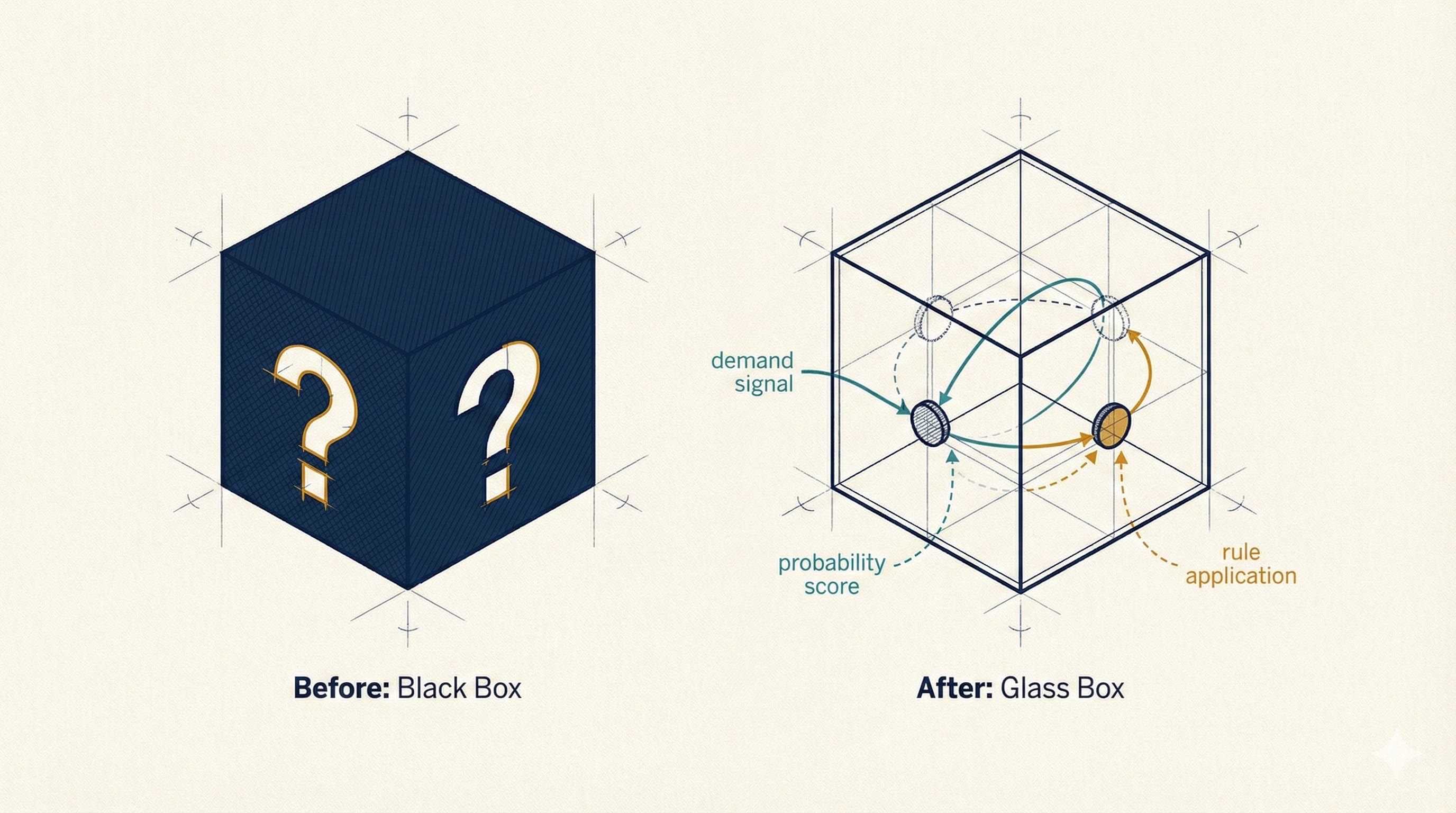
This isn’t a black box. It’s a glass box with a paper trail. These are reliable ways to build contexts that builds on the same principle of making context traceable that we discussed earlier in this series.
If a regulator asks, “Why was this ticket priced at $X?”, the logs now shows the full decision path → Demand signal → probability score → rule application → and whether a human intervened.
The Impact - How simple layering save reputation and money ?
Now here’s is the interesting bit and this is important because the numbers weren’t static:
Because of layring structure the revenue actually improved ranging from 10–15% during off-peak periods to upwards of 35–40% during high-demand seasons. The swing depended on route density, seasonal demand patterns, and most importantly how aggressively the old system had been mispricing.
The biggest lifts came during peak travel windows where the previous system was either leaving money on the table by overpricing or losing conversions by breaching price sensitivity thresholds.
On the risk side, now we have zero regulatory fines after deployment. And even if rules change we now exactly how to address that in our layer. With full audit trail for every pricing decision, the final decisions that used to take a 3-day approval cycle now almost happens in real-time.
We didn’t change the AI model. We changed the architecture around it and that’s what unlocked the value.
Most people are still stuck or are spellbound by the AI Hype and buzzword and new tools. But real money mostly realize after having a good scaffold and architecture around it. GenAI and LLMs are not a precision tool, the value isn't in the model alone, it's in how you wield it.
Governance as a Profit Equation Pillar
Remember the Profit Equation from Post 1:
Profit = (Revenue − Cost) | CSAT, Efficiency, Governance
Governance isn’t just about compliance. It’s about protecting the P&L. In the airline case:
Revenue: Double-digit lift by optimizing price alongside loyalty behavior and not just demand signals
CSAT: Customers trusted pricing because it was consistent and explainable. Loyalty members saw logic in their discounts, not randomness.
Efficiency: Real-time decisions instead of approval bottlenecks. Manual audit overhead eliminated.
Governance: Regulatory compliance + full audit trail = zero violations
Here is brutal fact - Most companies treat governance like a cost center, something that need to just check off. But the smart ones treat it like a profit lever. Because when governance is built into the architecture, it doesn’t just reduce risk. It unlocks value by reducing friction. Have you ever seen a cyclist with a cranky bi-cycle ?
And this is what we exactly map in Day 3 of the AI Profit OS cohort: the ROI Grid. We don’t just calculate cost and revenue, we quantify risk mitigation. Governance isn’t a soft metric. It comes with a dollar value:- the cost you didn’t incur because the system prevented a failure.
The Red Flags: How to Spot Governance “Theater”
If your Tech or AI governance looks like this, unfortunately it’s not real.
Red Flag 1: The governance document was written by Legal, not the people building the tech and the models. Legal understands compliance, not operations. If the people who write the rules don’t understand how the system works, the rules won’t be enforceable. (This is one reason why strategic AI literacy at the leadership level matters so much.)
Red Flag 2: No one can explain what happens if the model recommends something outside normal bounds. If your system doesn’t have automated edge case detection and human-in-the-loop triggers, governance is reactive (after the problem), not proactive (before deployment).
Red Flag 3: Governance is a separate “team”, not an active part in the development process. If governance happens after the model is built, you’re retrofitting safety instead of architecting it. That’s darn expensive, slow, and usually ineffective.
So what is the teal Governance Question Leaders should ask ?
Before you deploy any Tech or AI system, ask:
“How does this system log decisions, flag edge cases, and trigger human review before something goes wrong?”
If the answer is “We’ll add that later” or “The governance team will handle it,” you’re building on sand waiting for sandstorm.
Design-first governance means:
Decision logging is built in from Day 1, not added later
Edge case detection is essential part to be automated, not manual
Human-in-the-loop is triggered by the system, not by user complaints
Explainability is a feature, not an add-on
Governance isn’t what you write in a policy document. It’s what happens when the Tech or AI encounters uncertainty, edge cases, or regulatory constraints. If you haven’t designed that logic layer, you’re governing with theater, not architecture.
If your governance strategy lives in a PowerPoint instead of your architecture, you’re managing theater, not risk. I help leadership teams design operational governance systems that scale with deployment, the same approach I used to protect $82M in AI spend across Fortune 500 engagements in retail, telecom, insurance, and automotive.
If you want to learn how to map governance into your AI architecture before deployment, I teach this in The AI Profit OS (Day 3: ROI Grid Mapping, where we connect governance to measurable business impact). If you need to audit your current AI initiatives for governance gaps and compliance risk, I run a Strategic Audit that identifies where your governance is theater vs. real.
If your governance strategy is a document instead of a system, you’re not just risking compliance, you’re leaving money on the table.